Creativity as Connection, Not Invention
Creativity isn’t divine lightning — it’s connection. In this excerpt from The Anatomy of Creative Blocks, we explore the neuroscience and quiet courage behind creative flow.

To my very first subscribers — you’re officially part of the “I was here before it was cool” club. The caffeine is free, the reflections are deep, and the spelling errors… occasional. ☕✨
I wanted to say thank you with a piece that sits at the heart of my new book — a chapter that reshaped how I think about creativity itself.
Creativity as Connection, Not Invention
We tend to imagine creativity as a kind of divine lightning — a flash that strikes the chosen few.
But the truth is quieter, more democratic, and far more human.
Creativity isn’t invention out of nothing; it’s the recombination of what already lives within us.
The act of creating isn’t magic — it’s the mind remembering how to weave.
Neuroscientist Roger Beaty discovered that creativity sparks when three normally separate brain networks begin to communicate:
- the default network (imagination and memory),
- the executive control network (focus and planning),
- and the salience network (attention to relevance).
When these systems synchronize, the brain makes unexpected associations.
Creativity, then, isn’t chaos — it’s connectivity.
The Quiet Science Behind Inspiration
What looks like a sudden “aha!” moment from the outside is, inside the mind, a quiet conversation between memory, imagination, and awareness.
It’s when an old memory bumps into a new possibility — and something sparks.
That spark isn’t divine privilege. It’s neurology.
But maybe the divine hides in the elegance of that design — in the way our brains mirror the universe’s endless appetite for connection.
Psychologist Anna Abraham defines creativity as “originality plus usefulness.”
It’s not enough for an idea to be new; it has to fit.
The creative mind is both explorer and editor — wandering through infinite options, then choosing the one that harmonizes with truth
The Courage to Connect What Doesn’t Fit
Long before neuroscience, writer Arthur Koestler called this meeting of opposites bisociation — when two thoughts that don’t belong together suddenly do.
A scientist reframing a question, a poet twisting syntax, a designer breaking a rule — all perform bisociation.
Every joke, every poem, every innovation begins with that quiet act of rebellion:
the courage to connect what convention keeps apart.
The Role of Rest
But connection rarely happens while we’re trying.
Researchers John Kounios and Mark Beeman found that insight often appears when the analytical mind relaxes.
Alpha waves rise when we daydream, shower, or stare out a window — when the mind finally stops guarding the gate and lets the ideas cross.
That’s why rest feels so fertile.
Creativity isn’t born from pressure — it’s born from permission.
It thrives in that liminal space between attention and surrender.
The Gravity of Ideas
If you listen closely, creativity feels a lot like gravity.
Ideas are drawn to one another as surely as stars gather into galaxies.
Perhaps we’re never inventing anything at all — only discovering constellations that were always waiting to be named.
So when you feel uninspired, remember: you’re not empty; you’re in incubation.
The connections are forming beneath awareness, arranging themselves into coherence.
Your only job is to stay available.
Let silence work its physics.
Let rest become your research.
Because creativity was never about lightning — it was about listening to the electricity already inside you.
And yes, I know! I wanted creativity to be all sparkle and adrenaline too — that rush of instant brilliance that feels like falling in love with an idea.
And it is — sometimes.
But most of the time, you just have to sit it out.
Or worse: be boring until it shows up. 😅
✴️ A Note from Me
If you’ve made it this far, thank you — and welcome to the “I was here before it was cool” club. ☕✨
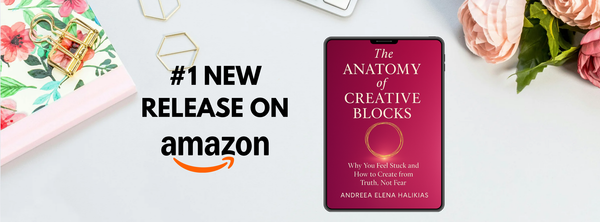
You’re reading one of the first letters from my upcoming book The Anatomy of Creative Blocks — a book about fear, permission, and remembering who you were before productivity became a personality type.
I wrote it because I got tired of pretending that creativity is a switch you flip when you’re “motivated.” It’s not. It’s a relationship — with silence, with self-doubt, with the messy in-between.
The book launches November 11th, and if you’re already here, you’ll get all the good stuff first: behind-the-scenes notes, the occasional typo confession, and maybe a little courage to start your own project again.
Until next week — stay caffeinated, stay curious, and let’s be a little boring until brilliance shows up. 😅
— Andreea